
ATA Carnet for Touring Equipment: What UK Bands and Crew Need to Know
7th October 2026 · Last reviewed 7th October 2026
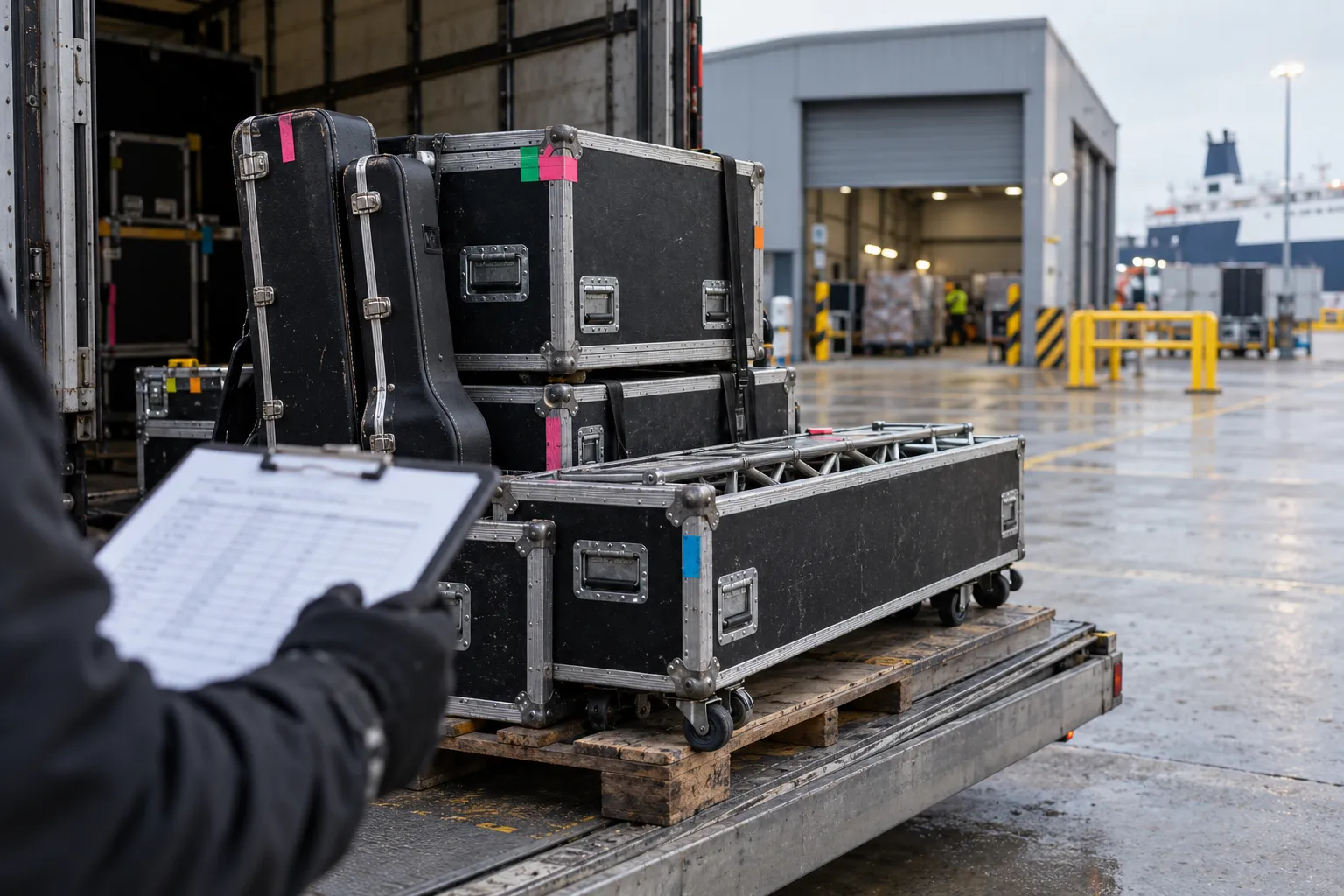
Visas get the people across the border. The gear needs its own paperwork, and when it is missing the problem tends to surface at customs on the way to load-in, with a truck full of backline sitting in a shed while someone works out what duty is owed on it. For most UK acts taking instruments, amps, lighting and sound equipment abroad and bringing them home again, the answer is an ATA Carnet, arranged before the tour leaves.
HMRC's own guidance, Applying for an ATA Carnet, describes it as "a document that works like a passport for goods", and names music equipment as an example of what it is for. This guide covers what a carnet does, what it costs once the security is added in, where it doesn't help, and how it fits alongside the visas for the band and crew.
What an ATA Carnet is
An ATA Carnet is an international customs document for goods you take abroad temporarily and bring back. The London Chamber of Commerce and Industry (LCCI), one of the UK issuers, describes it as allowing "the temporary admission of Commercial non-perishable goods into more than 80 Countries/territories globally for up to 1 year" (LCCI).
The practical benefit is set out on GOV.UK: "Using a carnet means you will not pay customs charges." It also replaces the customs documents you would normally complete in the exporting and importing countries and "removes the need for a customs declaration", although GOV.UK notes that goods moving as freight may still need to go on form C21i in the Customs Declaration Service. Instead of declaring the same backline in every country on the routing, you present one document each time.
Does touring gear count?
Yes. Carnets cover three broad categories of goods, and touring equipment sits in the one LCCI calls professional equipment: "tools and equipment required to perform a paid commercial activity abroad", with examples including "theatrical effects, orchestras" and "broadcasting equipment". GOV.UK lists "music equipment" and "film and sound equipment" among its examples of goods you may temporarily export.
Two conditions come with that category. LCCI states that "Professional equipment must be used by, or under the personal supervision of the holder or his nominated representative", so the gear needs to travel with the act or someone responsible for it. And GOV.UK is clear on the core condition for every carnet: "You must be intending to bring the goods back to the UK."
GOV.UK adds one condition that matters on a long run: you cannot process or repair the goods while they are outside the UK, "except for routine maintenance to keep them in their original condition". Everyday upkeep is fine; an amp that needs a proper repair mid-tour is a question for your issuing chamber before anyone opens it up.
Why merchandise doesn't go on the carnet
A carnet is built for goods that come home. Merch sold on the road is not coming back, so it falls outside what a carnet is for, and it needs its own customs treatment in each country where it is sold.
The consequences of getting this wrong sit with the carnet holder. GOV.UK says you will be "responsible for any customs charges that may become due" if you do not use the goods or carnet correctly, or do not re-export the goods from the country you visit. Where goods listed on a carnet end up staying in a country, the holder has to contact that country's customs and "fill in a full export declaration to replace the temporary export made under the carnet" (GOV.UK: How to use your ATA Carnet). Keep the merch off the carnet from the start and ask your freight forwarder or customs broker how it should be shipped and declared.
LCCI's FAQ is similarly narrow on consumables: "The only instance when consumable / perishable goods are allowed on a Carnet is if they are being exhibited at a Trade Fair or similar event", and that exception excludes alcohol, fuel and cigarettes (LCCI ATA Carnet FAQs). Spares and supplies you expect to use up on the road don't belong on it.
How much an ATA Carnet costs
There are two separate costs: the fee for issuing the carnet, and the security that guarantees any duties would be paid if the carnet were misused.
LCCI's published issuing fees, including VAT (verified October 2026):
- Member: £225.00 plus £45.00 VAT, £270.00 in total
- Non-member: £370.00 plus £74.00 VAT, £444.00 in total
LCCI also offers an express service at extra cost; ask the chamber for the current price. Other chambers set their own prices, so treat these as a worked example rather than the going rate.
The security is on top. LCCI calculates it from "the country(ies) to visit, the duration of the trip, and the type of goods exported", and accepts it in three forms:
- a banker's draft or cash deposit "for the full security amount (refundable after the Carnet has been discharged)"
- a bank guarantee, returned to your bank once the carnet is discharged
- the Carnet Security Scheme, "a non-refundable, one off payment" that avoids tying up funds
Budget for the fee plus the security, not the fee alone. A deposit comes back once the carnet has been discharged, so it affects cash flow rather than the final cost. The security scheme payment is not refunded, and LCCI points out that the holder is still liable for duties if the carnet is misused.
How long it lasts
LCCI's FAQ says a carnet "is valid for 12 months from the issuing date", but it "can only be used for the period of time the security coverage allows", which can be 2, 6 or 12 months. Customs in each country can still set their own time limit on how long the goods stay. LCCI's advice for getting value from a carnet is to include every country you might visit, and every item you might take, across the 12 months.
Where you get one
You apply to an issuing Chamber of Commerce, not to HMRC. GOV.UK says "You'll need to apply for a carnet with one of the Chambers of Commerce listed on the UK National ATA Carnet Organisation website", and that list is on the UK National ATA Carnet Organisation site. LCCI is one of those chambers, not the only one.
The application asks for more than a kit list. GOV.UK says you must give "detailed descriptions of your goods so that customs authorities can identify them", and you can include photographs. You also need to list the countries the goods will visit and pass through in transit, describe how you will use them, and give the number of consignments that will bring the goods back to the UK. If the descriptions are not clear, the importing customs authority can refuse the carnet or delay releasing the goods. A backline inventory with model and serial numbers is the obvious starting point.
On timing, LCCI reviews standard applications "within 24 hours of submission" and express ones within 2 hours, in office hours, with postage or collection on top. That is quick, but the security arrangements and a complete goods list take longer to pull together than the application itself, so start well before the tour.
Using the carnet on the road
GOV.UK's rule is simple: "You must show the carnet at customs each time you import or export your goods." That includes goods entering or leaving Great Britain and Northern Ireland, so it applies on the way out of the UK and on the way home, not only at foreign borders. It is your responsibility to make sure customs officials "either scan your digital carnet in your ATA Carnet app, or stamp your paper carnet". If gear comes back to the UK in a passenger's baggage rather than as freight, GOV.UK says the carnet "must be shown at the red point or channel".
Missing a stamp or a scan is not a formality. GOV.UK warns that you may have to pay customs duty, taxes and a penalty if, for example, "the carnet was not scanned or stamped when you imported or exported the goods".
Carnets are part-way through a move to digital. On 1 June 2026 the UK, the EU, Norway and Switzerland began switching to digital carnets presented as QR codes from an app, according to LCCI, which says a second group of countries will follow later in 2026 and that "The traditional paper carnet will be phased out by 2028". For a tour that mixes digital and paper destinations, LCCI issues a parallel carnet and the holder presents the right format at each border.
Touring the US or Canada with a carnet
The US accepts carnets for touring gear. LCCI's country notes say the United States takes carnets for "Commercial Samples and Professional Equipment only at present", and backline falls under professional equipment.
Canada needs more care. LCCI lists Canada as "Commercial Samples only", adding that for the professional equipment category "we will require a letter of indemnity on your company headed paper, accepting responsibility if the Carnet is refused". If a North American routing crosses into Canada, raise that with your issuing chamber early.
The carnet covers the gear, not the people
A carnet does nothing for the people travelling with the equipment. A US run still needs work visas for the band and crew, usually O-1B for the artist and O-2 for essential crew (see our O-1 and O-2 visa guide for musicians and touring crew and the wider picture in US tour visas for UK bands). A European leg brings its own limits on how long non-EU crew can stay, covered in our guide to the Schengen 90/180 day rule for touring schedules.
Paramount Visas does not arrange ATA Carnets: for those, go to one of the issuing chambers listed above. The carnet covers the gear; our tour support team handles the visas and travel authorisations for the people travelling with it. If you are planning a run and want the band and crew paperwork mapped out alongside the dates, get in touch.