
P-1B Visa for Touring Bands: Does Your Group Qualify, and What About the Crew?
7th October 2026 · Last reviewed 7th October 2026
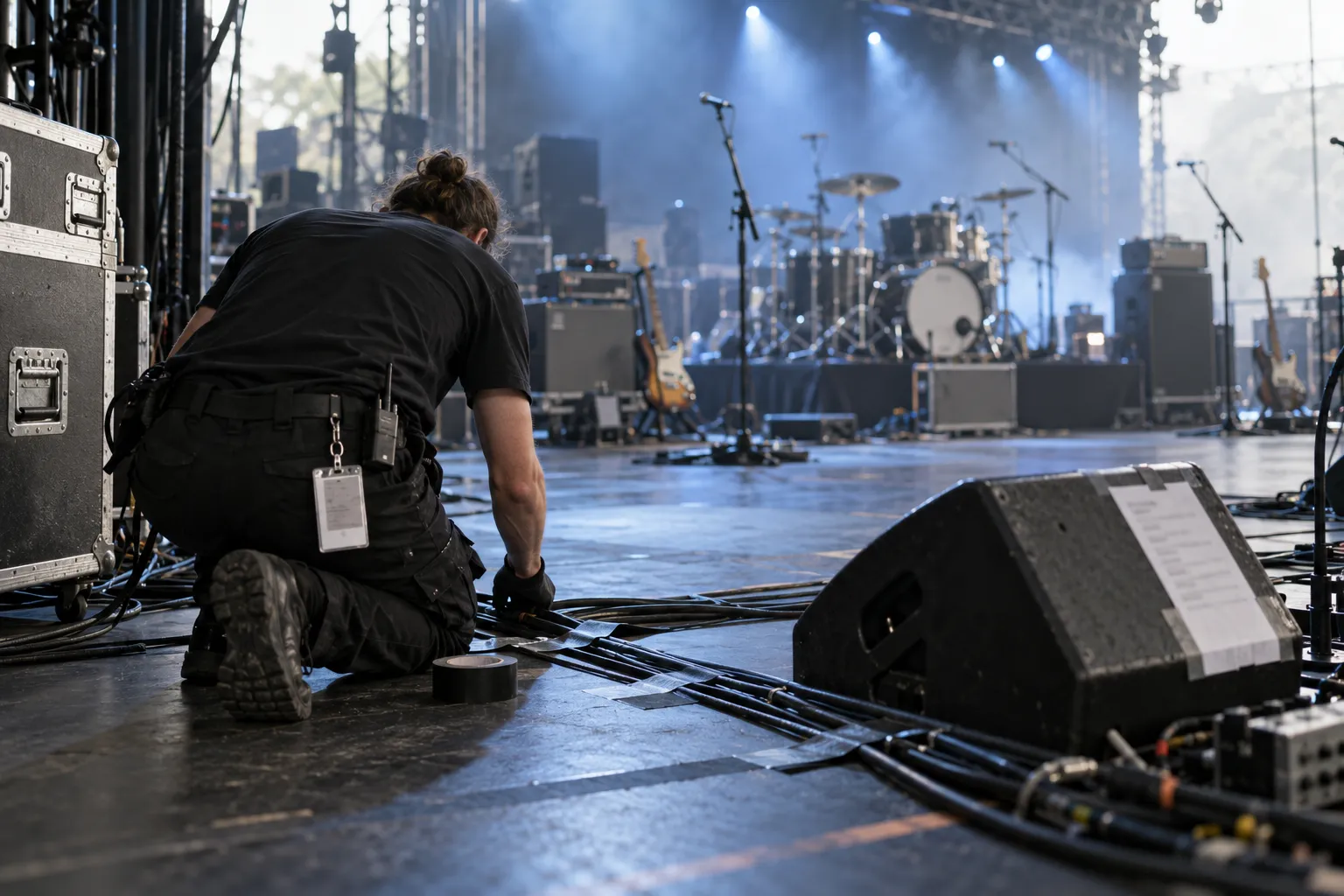
Search for a US work visa for a band and P-1B is usually the first category that comes up. It is the one built for groups: the petition rests on the reputation of the band as a unit, not on any single member. That makes it look like the obvious choice, and for some acts it is. For many others it is the wrong tool, either because the lineup does not meet the group tests or because the one-year cap makes it poor value for an act that plans to come back.
This guide works through the P-1B requirements and the separate crew petition, then compares the category with O-1B. USCIS sets out the category on its P-1B page, and the detailed rules sit in 8 CFR 214.2(p). A qualifying US petitioner can file the petition with USCIS directly, with no visa adviser required.
What a P-1B visa covers
P-1B is for a member of an entertainment group that has been "established for a minimum of one year and recognized internationally as outstanding in the discipline for a sustained and substantial period of time", in USCIS's words. The group is the thing being assessed. USCIS is explicit that "the reputation of the group, not the individual achievements of its members or the acclaim of a particular production, is essential."
Two consequences follow. A solo performer cannot use P-1B on their own: the regulations define a group as two or more people established as one unit to perform. And a P-1B member may not perform services "separate and apart from the entertainment group". A solo set or a session for another artist on the same trip falls outside what the petition covers.
The USCIS Policy Manual also confirms that P-1B can cover someone coming to join an internationally recognised group as a new member, and that the group can be based in the US or abroad.
Does your group qualify for P-1B?
The group has been established for at least a year
The petition needs evidence that the group "has been established and performing regularly for a period of at least 1 year" (8 CFR 214.2(p)(4)(iii)(B)). Releases, dated show listings, contracts and press from that period all help to show it.
The 75 percent rule
This is the test that catches most bands out. USCIS states: "At least 75 percent of the members of your group must have had a substantial and sustained relationship with the group for at least one year." The petitioner has to file a statement listing each member and "the exact dates for which each member has been employed on a regular basis by the group".
The arithmetic is unforgiving for small lineups. In a four-piece, one member who joined eight months ago leaves the group at exactly 75%. Two recent arrivals in that four-piece and the group no longer meets the rule. "Member" here means someone actually performing: the regulations define a member of a group as "a person who is actually performing the entertainment services", which is why crew are dealt with separately (see below).
There is one narrow waiver. Under 8 CFR 214.2(p)(4)(iii)(C)(3), USCIS may waive the one-year requirement for someone who, "because of illness or unanticipated and exigent circumstances, replaces an essential member" of the group, or who augments it "by performing a critical role". That is designed for a genuine emergency replacement, not for a lineup that has simply changed over the past year.
International recognition
The group must be internationally recognised, which USCIS defines as "a degree of skill and recognition substantially above that ordinarily encountered, to the extent that such achievement is renowned, leading, or well-known in more than one country."
The evidence can be the group's receipt of, or nomination for, significant international awards. Without that, the petition needs at least three of six types of evidence, which in summary are:
- starring or leading performances in productions or events with a distinguished reputation
- international recognition shown through reviews in major newspapers, trade journals or magazines
- leading or starring performances for organisations and venues with a distinguished reputation
- a record of major commercial or critically acclaimed success, such as chart positions, sales or box office
- significant recognition from critics, organisations, government agencies or recognised experts
- a high salary or other substantial remuneration compared with others in the field
The full wording is on the USCIS P-1B page and in the regulation. The emphasis throughout is on "more than one country": a band with a strong UK following but nothing beyond it has a harder case.
USCIS can waive the international recognition requirement in limited cases. Its page says that "certain nationally known entertainment groups may have the internationally recognized requirement waived if they can establish they have been recognized nationally as outstanding in its discipline for a sustained amount of time in consideration of special circumstances." The regulation gives limited access to news media or "consequences of geography" as examples of special circumstances. It is discretionary, and it is not a route around a thin press file.
Solo artists with a regular backing band
The Policy Manual addresses a common setup directly. If a solo artist "traditionally performs on stage with the same group of people, such as back-up singers or musicians, the act may be classified as a group", and that group then has to meet the 75 percent rule.
It also says what happens if it does not: "the artist or entertainer would need to qualify for another classification, such as an O-1 nonimmigrant (rather than P-1B) and the back-up band as O-2 nonimmigrants." Our guide to O-1 and O-2 visas for musicians and touring crew covers that route in detail.
What about the crew? P-1S essential support personnel
Crew are not members of the group for P-1B purposes. The Policy Manual says support staff who are not on stage, "such as lighting or sound technicians", need to be "petitioned for as essential support (P-1S) and a separate petition must be filed for them." The regulation is just as direct: "Essential support personnel may not be included on the petition filed for the principal alien(s)."
To qualify, a crew member must be "an integral part of the performance" of the P-1 group and perform "support services which cannot be readily performed by a U.S. worker". USCIS lists "front office personnel, camera operators, lighting technicians, and stage personnel" as examples. The regulation adds that the person must have appropriate qualifications, "critical knowledge of the specific services to be performed, and experience in providing such support" to the group.
The P-1S petition needs its own supporting documents:
- a consultation from a labour organisation with expertise in the crew member's skill area
- a statement describing each person's prior essentiality, critical skills and experience with the group
- a copy of the written contract, or a summary of the terms of an oral agreement
One practical difference from the band's petition: a group's members can be substituted on an approved petition by letter to the consulate or port of entry, but "essential support personnel may not be substituted at consular offices or at Ports-of-entry." Adding new crew means filing a new petition. If the crew list is still moving, that is worth knowing before the petition goes in.
How the petition is filed
The petition is Form I-129. It can be filed by a US employer, a US sponsoring organisation, a US agent, or a foreign employer through a US agent. A UK employer with no US presence cannot file directly: the regulations treat any employer that cannot be served with legal process in the US as a foreign employer, and foreign employers "may not directly petition for the alien but must use a United States agent". Where an agent files for several employers or venues, the itinerary has to show the dates of each engagement and the names and addresses of the employers and venues.
The band's petition must include:
- a written consultation from an appropriate labour organisation
- an itinerary with the dates and locations of the performances
- a copy of the contract between the petitioner and the band members, or a summary of the terms of an oral agreement
- the evidence of the group's year of regular performing and its international recognition
- the statement listing each member and their dates with the group
USCIS will not accept a P petition "more than one year before the actual need for the alien's services". Up to 25 named people can go on a single P petition, so most bands fit on one filing, with the crew on a second.
After approval, each traveller applies for the visa itself at a US embassy or consulate, with a DS-160 online application. The State Department's visa pages set out the consular stage for each post. An ESTA does not cover paid performances, so it is not a fallback if the petition is late. Equally, a past ESTA refusal does not close this route: our guide on what to do if your ESTA is refused explains what a refusal does and does not affect.
How long a P-1B lasts
A P-1B petition is approved for the time needed to complete the event or tour, "not to exceed one year". Extensions are available in "increments of up to one year to continue or complete the event, competition, or performance". The P-1S crew petition follows the same rule: valid for the length of the event, up to a year.
The regulations allow entry up to 10 days before the petition's validity period begins and up to 10 days after it ends, but work is only permitted during the validity period itself. Spouses and unmarried children under 21 can travel on P-4 status. They may study but not work.
What it costs
These are the USCIS and State Department fees for a P petition (verified October 2026 against the USCIS fee schedule and the State Department's fees for visa services). Check the linked pages before budgeting, since fees change.
- Form I-129, P petition: $1,015, or $510 for a small employer or nonprofit, with up to 25 beneficiaries per petition
- Asylum Program Fee: an extra $600 per I-129, or $300 for a small employer and $0 for a nonprofit
- Premium processing (Form I-907), optional: $2,965 per petition, for which USCIS commits to taking adjudicative action within 15 business days
- Visa application fee at the consulate: $205 per person for P categories
For a standard petitioner, that makes the band's petition $1,615 and the crew's P-1S petition another $1,615, before premium processing or any consular fees. Premium processing on both adds $5,930. Bear in mind that "adjudicative action" can be a request for more evidence rather than an approval.
There is also a fee in law that is not yet on the State Department's schedule. Section 100007 of Public Law 119-21, enacted on 4 July 2025, created a Visa Integrity Fee of at least $250, payable "by any alien issued a nonimmigrant visa at the time of such issuance", which would include P visas. When we checked the State Department fee schedule in October 2026 it did not list a Visa Integrity Fee, so it is not included in the figures above. Check the schedule before budgeting, in case collection has started.
Outside premium processing, timings vary, so build the filing into the tour calendar early rather than relying on a particular turnaround.
P-1B or O-1B: which route fits your band?
On paper, P-1B is the natural fit for a band. In practice we very rarely recommend it, and the one-year cap is the main reason. A P-1B petition runs for the length of the tour and no more, so a band that comes back for a festival next summer or a second leg in the autumn files a fresh petition each time, paying the fees and going through the consular stage again.
An O-1B petition can be approved for up to three years, with O-2 petitions covering essential crew for the same period. For an act treating the US as a recurring market rather than a one-off trip, that usually works out as better value. The trade-off is a higher evidential bar: O-1B is assessed on the individual artist's distinction, and not every act can show that yet.
P-1B can still make sense for a one-off run by a group that comfortably clears the 75 percent rule and has a strong international press file. If the lineup has changed recently, or there is any chance of a return trip within a few years, it is worth comparing the O route before committing. Our overview of what visas a UK band needs to tour the US sets out all the options side by side.
Our tour support team handles O and P petitions alongside the rest of a touring schedule, from the consultation letters to the crew filing. If you are weighing up P-1B against O-1B for your lineup, get in touch with your dates and we can work through it with you.